
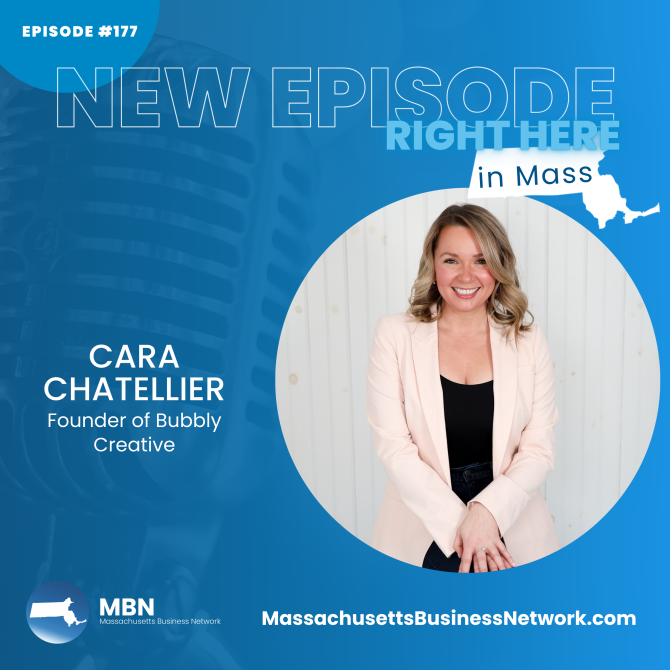
Cara recently spoke on an episode of Massachusetts Business Network’s show Right Here in Mass, a weekly podcast that features individuals throughout the Bay State, to dive into all things marketing.
Can you share a little about Bubbly Creative?
Bubbly Creative is a full-service digital marketing agency, and we often act as an outsourced marketing department for small service-based businesses, like your dentist, doctor, or financial advisor, for example. We primarily focus on female-owned businesses because, as women, we know how difficult it can be to put yourself out there and start a business. We do everything from website management to social media management, creating social posts, design, blogs – basically everything when it comes to digital marketing, and even some traditional marketing as well.
How did you get into marketing, and what inspired you to start Bubbly Creative?
I graduated in the peak of the recession. It was 2009, and I had a degree in communications from UMass Amherst. At the time, if you were outgoing, sales was really the only place hiring if you weren’t skilled in a trade. So, I went into sales and was working for an advertising company, doing cold calling and selling advertising, then I went to recruitment. This was very eye-opening and not easy, so I give a lot of credit to salespeople. Being in sales, you learn how to think on your feet really fast. You learn how to draft messages that are compelling because you’re reaching out to people all the time. I think this really helped me from a marketing perspective, but something about sales always felt like I was being held back a little bit. I wanted to be more creative.
I ended up getting a position in higher ed at Brandeis University in Waltham, where I did corporate relations and marketing for them. This was my toe dip into marketing, where I was able to generate blog content and social content and be a little bit more creative. I realized I really liked that, and while I was at Brandeis, I decided I wanted to take a big leap, and I moved to Madrid. While I was there, I was freelancing. It was 2016, and freelancing was only kind of talked about. I had googled “how to freelance” and found Upwork. I started finding clients on Upwork, which now seems impossible because it’s just become overrun and is incredibly competitive. The prices are so low, so I was glad I got in when I did and actually met some really great clients there.
I was freelancing in Madrid for US companies, so because the cost of living is so much lower there, I was able to take bigger risks. I was there for three years and supported myself full-time, which was great, and moved home in 2019 and realized I wanted to focus more on my business. I was saying to my clients all the time, “You really need to lean into your brand and thread your brand messaging through everything you do externally.” I wasn’t practicing what I preached, so I decided in February 2020, which is so funny now in hindsight, to launch Bubbly Creative. It’s one of those things where when you’re a freelancer, and I think most people who start their own businesses, kind of have that entrepreneurial mindset and are always asking themselves what’s next – how can I grow this and how can I keep moving that needle? That was the next logical progression for me.
What was it like going from being a freelancer to now building an agency?
It’s been really fun, really challenging, really interesting, you know, all the things! At one point, I was kind of mourning the loss of my intern-turned-assistant, and a client told me that the only constant in your business is you. This was really impactful to me because you don’t realize it.
I have 2 full-time employees and work with a lot of freelancers and agencies really closely, but the two women who work for me have been with me for 3 or 4 years. They’re incredibly important to me, and obviously, employees are always going to be important to you, but sometimes you need to think about it like, I’m the constant here. I need to figure this out on my own. The stakes are much higher, right? When you’re supporting two full-time salaries, you have a lot more pressure on you. You need to make a certain amount of revenue, things need to be running a certain way, so you have to pivot a lot. It’s a lot more challenging, but in a really exciting, fun way.
How do you know what the right choice is when it comes to hiring someone as a contractor/freelancer or as an employee?
The two employees I have now that are full-time, Liv and Isabel, I hired them both. They both started part-time because I wanted to get to know them better and be sure it was the right fit. From a growth standpoint, that’s just kind of where I was at. For us, we generate a ton of content every month – a lot of social calendars, a lot of blog content, a lot of design – so when we got to a certain point of growth where I had enough clients, full-time made sense. When I find something that’s like, okay, we’re doing this every day, and the demand is too high, I need someone on staff, and that’s when I go full-time.
There is a difference from an ownership perspective of the individuals who work for you as employees and those who work with you as freelancers. Because, for example, with my employees, they’re in my photoshoot, they’re all over the website, they’re in our photos on social media, they are a part of this. It’s still, even after 5 years, very much ground floor. It feels like they feel very involved, which I think is really important when you’re trying to grow something, and you want people who are psyched about what you do and show up for your clients. When you have one-off things, a contractor makes sense and someone who’s a real expert, but when it’s more general things that our clients and we need constantly, and it’s a ton of demand, I think having full-time employees makes sense. If I’m bad at something, for example, I’m terrible at bookkeeping, you outsource that. Looking at QuickBooks is hell, but I don’t need an accountant on staff.
What do small businesses in Massachusetts need to know when it comes to marketing?
First of all, don’t try to do everything, please. You just can’t! Sometimes, I’ll talk to businesses, and they’ll say okay we need to do TikTok, LinkedIn, Facebook, X, Instagram, Snapchat, and all the things, but their ideal customer is a 55-year-old woman. She’s probably not on TikTok, and she’s definitely not on Snapchat. She barely knows what X is, so I don’t think you need to be there. I think this has become cliché, unfortunately, but being authentic to your brand and really knowing who your brand is, who you’re talking to, what you’re talking about, and why you’re talking about it is incredibly important.
As a business owner, try to prioritize low-hanging fruit. You already have your current customers, so talk to them about how they feel about your messaging and your branding. They are already someone you trust and have seen your online presence. Lean into the people you know in your target market and ask them:
- Do you like what you’re seeing on our social media? Is it resonating with you?
- What do you think about our brand?
- What do you find interesting? What would you be interested in hearing about in a blog?
- Is our website easy to navigate?
- Is it easy to find us online?
My biggest tip is to outsource to an expert. Content and marketing take a ton of time. I talk to business owners all the time who are just like, “I hate marketing. I don’t want to do it,” and I’m like, I know, that’s why I have a business! I’m glad you don’t like doing it, and I’m glad we’re talking.
If you don’t have the budget to outsource, though, lean into the free tools available to you and just show up authentically as you. Show pictures of your team, talk about what you do, why you do it, how your business is different, why you care about your clients, client testimonials, and your owner story – people love seeing pictures of you. They just do! Take advantage of having an amazing little computer camera in your pocket and spend an hour each month planning.
Another important thing for business owners to know is that AI is a tool, not a marketing strategy. It can help in a lot of ways, but please don’t generate AI images and share them on social media!
Are there certain marketing channels business owners should be prioritizing?
It’s very dependent on businesses and what their goals are, of course, but I think broadly speaking, video is incredibly powerful and important. Try to be self-aware, though, because if you don’t show up well on video, it could actually have the adverse effect that you want. In this case, there are still ways to create video content. Use a voiceover and some great b-roll!
Depending on the nature of your business, email is so impactful. People are annoyed by email a lot, but it just works. If you’re a product-based business, you absolutely need email big time, but service-based businesses can benefit as well. I have a dentist client who was really anti-email marketing, but we convinced them to try it for a few months, and referrals and services from current patients increased a ton. There is a stigma around it, but it doesn’t have to be all sales. Some emails are more informational, sharing what we’re doing in the office, what staff are up to outside of work, and other interesting things.
Google ads truly cannot be beat; however, they are incredibly intricate, so I would say, again, outsource. Don’t try to take on Google ads by yourself. If you’re desperate for new clients, talk to an agency. These will help drive a lot of new traffic, both food and digital, if they’re done properly.
Social is also incredibly important. Lean into storytelling and show up in a way that people get to know who you are and who you’re trying to reach. Anything that adds a personal touch, and anything you can do that feels genuine and like you actually care, and isn’t AI, is going to stand out.
What’s your advice for being able to get leads or close the deal in a way that feels good?
First, it really helps when someone comes to you. This is the best-case scenario. You don’t feel like you have to close too hard because they want what you’re selling. This is dreamy, everyone wants that.
When you have to go out into the world and kind of pitch yourself, have that elevator pitch ready, but you need to have that baseline interest. If someone doesn’t see the value in what you’re offering, don’t bend over backwards to show them the value. They might just not ever see it, and that’s okay! They’re not for you. Knowing when to walk away is incredibly important. I learned this really early on. I remember talking to this architecture firm, and the woman was like, “Well, why do I need marketing? It just seems stupid.” And I just said okay, I’m not going to waste my time trying to prove that you need it then.
Try to get in front of people where they are. Find where your ideal client hangs out and be there, whether it’s a networking event, or you’re speaking at a conference, or you’re speaking on a podcast. It’s kind of a slow burn, but make yourself known and try to show up and do the things where they’re going to be looking for someone like you. Become that expert.
I take a very relaxed approach to sales, so if I’m having a conversation with someone, I just want to know what they need, why they need help, and how we can try to meet those needs. You really don’t want to have to do that hard sell and be annoying with it, it doesn’t feel good for anyone.
What’s one thing you know now that you wish you knew back then when you first started Bubbly Creative?
One thing that I’ve always kind of done is say yes. I love Tina Fey and read her book Bossy Pants, where she says something along the lines of say yes and figure out the rest later. I still do this to an extent where I know I can find an expert to pull in as needed. This mentality of “I know I can do it, I just need to find the right person to help me” has served me well.
Right now, I know very well what my expertise is. I think early on it was a little more like help anyone, but now it’s very different. Saying yes to a lot of things, figuring it out, and seeking expertise did help me to learn exactly who I wanted to work with, so I think it did end up serving me well. But I also think a huge thing is outsourcing when you’re not an expert at something. Find people who you can trust and find great people who you can work with who don’t have to be employees. Maybe it’s another agency, a great freelancer, or someone you know who is reliable and you can call in a pinch.
What I would say to my former self is you’re going to be scared. If this client or project feels a little scary, you can do it. You just need to take it bit by bit. I still get the same fear if it’s a big client or a big project, and it feels like it’s a lot to take on, but you just have to take it step by step. I’ll always bust my butt to make sure I’m doing everything I can for our clients. It’s always going to turn out well if you have the skills and the effort, which I know we very much do. So just knowing sometimes you’re going to be scared and that’s okay. Do it scared.
Knowing that the North Shore is your sphere, what are your favorite local businesses to support?
One I have to shout out is my sister’s small business on Etsy called Oceanside Sail Bags. She lives in Beverly and makes sail bags from recycled sails. They’re all from different sails, and she does custom designs on them.
Some other favorites are:
- Settler in Salem
- Lulu’s Cafe in Salem
- Atomic Cafe in Beverly
- Worth Girl Thrift Shop in Beverly
Want to hear the full conversation? Listen to the full episode of Right Here in Mass now.