
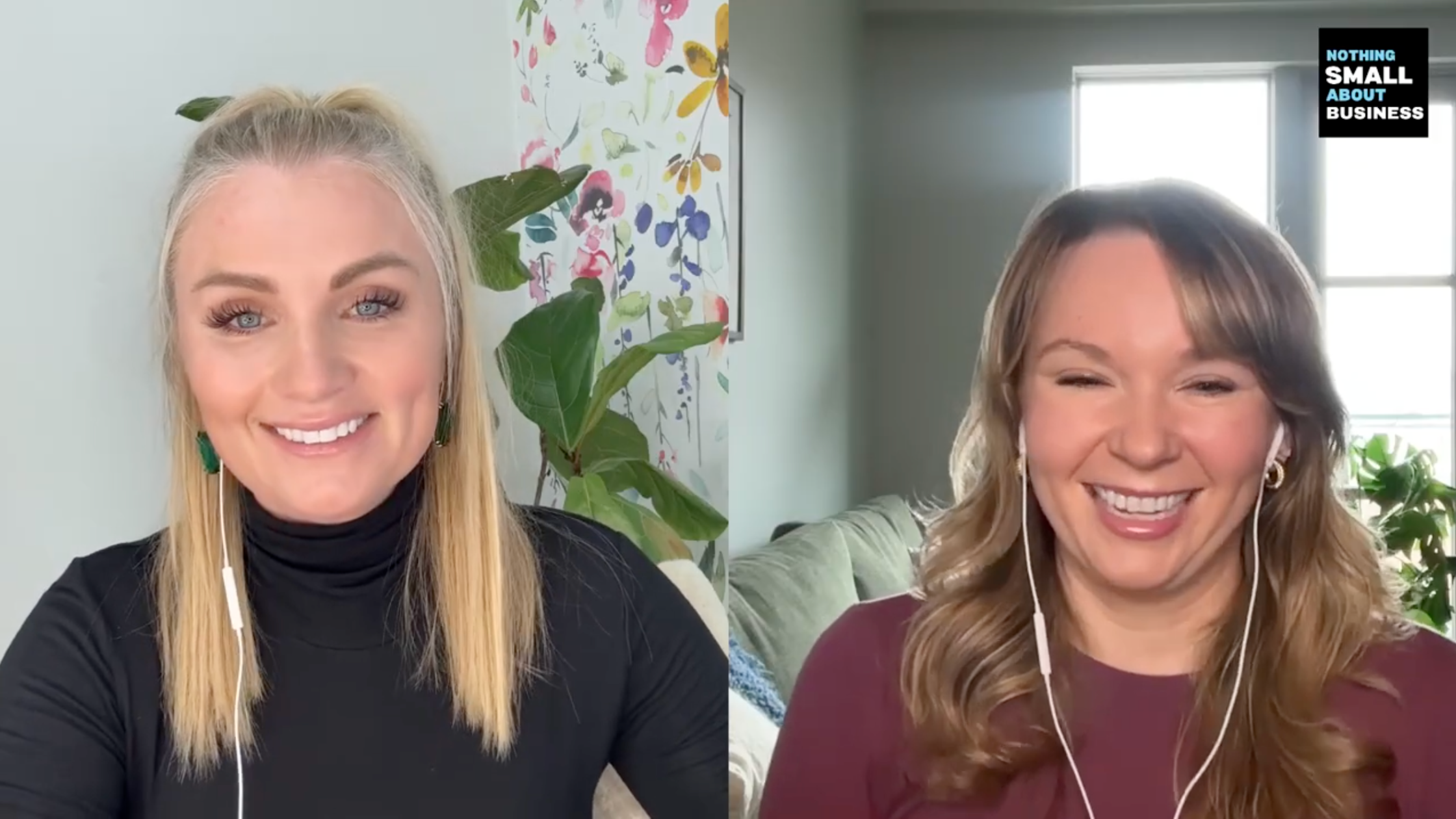
Bubbly Creative’s Founder & Creative Director, Cara Chatellier, recently joined host Sara Press on an episode of Nothing Small About Business. Here’s what Cara had to say about the challenges businesses face in marketing, the evolving landscape of social media, SEO in the age of AI, and more.
Can you give me a brief overview of what you and your company do?
Bubbly Creative started in 2020, which I always like to mention because it’s such crazy timing. We recently started to niche down a little more to focus on female-owned health and wellness providers, which is something that I’m really passionate about and really hits close to home.
Doctors are amazing, but a lot of times they really struggle. They’re brilliant in what they do, but marketing just does not come easily to them, so that’s where we can step in to help bridge that gap and help them find their ideal patients. We offer a full suite of digital marketing. We have developers and designers on our team, we do website maintenance, social media, digital ads, whether that’s on Google or Meta, and we’re even dipping our toe into Reddit – basically everything digital that a health and wellness brand may need.
In terms of social media, what are you seeing in that market, and where do you see it going?
Last year, one of the things I was talking about a lot was less-produced content. Often, doctors want to be very polished, but authenticity is what will really resonate. People want to see the messiness. Humanization is a focus we prioritize with healthcare providers because they tend to be so clinical, professional, and science-backed. This is great, but for a potential patient who may be getting their first Pap smear at 18, or someone preparing to deliver a baby, you want to work with someone who feels more human and approachable, in addition to being knowledgeable.
I do see people a little bit fatigued with social media and being online in general. They need a more genuine connection. When it comes to making content that creates this connection, you just have to try. I went to a conference at the end of 2025, and what stuck with me most was a panel of women who essentially just said, “Be weird.” Do the weird thing, try something different, and see what happens.
When you’re working with a business, are you implementing different strategies based on the platform?
Definitely! On LinkedIn, for example, it’s good to have a little presence on a company page, but individual profiles are really what get attention. If someone is B2B, trying to sell to other business owners, they really need to speak to those individuals from their business profiles. Instagram is way different; you can have more fun on there.
Facebook really depends on the demographic. If we have a client trying to reach people in their 50s and 60s, which we do, we post a lot on Facebook and have seen a lot of benefits. Video content tends to be more long-form and slower, and people love it. Knowing your demographic really well is important.
Why is human connection so important in marketing?
Right now, with AI and the influx of AI content, people are starting to feel very turned off from that content. It’s not even just on social media; it’s everywhere. As a business owner, I get so many emails every day that are so clearly AI, and it drives me insane.
If you look back at social media around 2013, when Instagram came out, it was all grainy photos. Then Reels came out, and it turned into more polished, influencer, and lifestyle content, which still plays, but at the end of the day, people want to see an actual human on the other side. They’re flawed, they’re not perfect. We’re trying to find connection in any way possible because we’re so disconnected in so many ways.
Whenever I talk to my audience, engagement just spikes. People just love seeing a real person behind the brand and knowing who they are. We’re leaning that way in so many different facets of business.
I have clients who are still B2B, and emails just aren’t working because of all the AI emails and so many cold emails coming in. People are leaning so much more into in-person events because of this. I’m just seeing so much movement toward being with people and actually meeting people. Go to these in-person events, host booths, do talks, and speak at events. Our B2B clients are also having in-person workshops. Of course, they have a Zoom option as well that people are still signing up for, but we’re seeing the in-person ones really blow it out of the water.
How do you get the most out of these in-person events?
Looking at the speaker page and agenda is hugely helpful. Sometimes you’re even able to get a list of attendees. This is incredible because you can say, “Okay, I want to target these people and make sure I talk to them,” and kind of set up a list of goals for yourself.
You could say: I want to talk to five people in this industry, I want to come out with six follow-up calls, I want this many business cards. Whatever it is, setting goals for yourself ahead of time is always helpful. It can also be good to scour LinkedIn.
Sometimes people post that they’re going to a certain event too, so you can search for the event or the event hashtag to see if anything comes up. You need to do the work ahead of time in addition to the work after the fact. Follow up with those people, add them on LinkedIn, try to get a coffee, whether that’s virtual or in person, if they’re close by!
One of the things that has been really helpful is having someone on your own team who can generate a list of events you want to focus on, so you can be strategic about which events you’re attending, in addition to how you approach the events and how you handle the aftermath.
How is SEO transitioning in the age of AI?
SEO, and now AEO, are important because people are using ChatGPT like a search engine. I don’t personally, but I have asked, “Take a look at my website and tell me, would you recommend Bubbly Creative to [insert ideal customer here]?” It will tell you yes, no, or I’m on the fence because of X, Y, and Z. I’ve done this for all of my clients, and it’s really interesting to see what it comes up with. You can also optimize what ChatGPT is searching for when your ideal customer looks.
I have an SEO expert on my team, too. I know enough to talk to my clients about it, but when it comes to the nitty-gritty, this is where she comes in. I can tell you the basics and help you with the metadata, your photo titles, your page titles, page structure, blog topics, and things like that, but I always want to bounce it off an SEO expert. If you hire one person on your team as a marketing generalist and they say they can do SEO and all of this stuff themself, it’s a red flag. SEO itself is a job.
As big as AI is, preaching to the search engines is still incredibly important. People are still going to be using Google en masse, and we don’t want to get away from that. It’s evolving alongside AI, too. Search engines are cracking down on AI content, which is great because there’s a lot of AI slop out there. If you’re getting flagged for AI content, it is going to ruin your ability to show up in search.
Can you explain the importance of content creation?
If you are a business, you want to get content out there because content is still important. Google looks at how often you’re updating your website, so this is why blogs are really important, especially if you’re generating worthwhile information. My recommendation is that if you can’t have human-written content all the time from a writer writing for you, or you can’t hire an SEO person, because small businesses are often running on razor-thin budgets, reach out to an SEO expert. Have them create some outlines of blogs for you, showing you what they need to look like, and then have someone freelance write for you based on those outlines. You can create some topics based on what ChatGPT, or whatever your AI of choice, thinks about your industry and what your website needs.
If you have a lot of technical information that belongs in these blogs, try utilizing voice notes. I have a lot of my doctors do this because they’re so busy, and we don’t want to get the medical stuff wrong. Ask them for a voice note on specific topics, then your writer can put them in the SEO templates, and you can put those on your site. Blog content does matter, and AI content is not going to do you any favors. Don’t try to be your own SEO person. Seek out an expert if you can.
How do you approach digital ads?
Anytime someone is doing something that is just throwing money into a pit and lighting it on fire, I’m like “No, don’t do that!” We’re small business owners, and we know what it’s like trying to do everything. They make it look like “Oh, hey, promote this as an ad to reach a thousand people,” then you go in, and Facebook, or Meta, rather, has automatic settings on. Despite the dimensions of your ad, this will make it show up on Facebook Marketplace, Facebook news (which I didn’t even know existed), or a little bit on a video that no one is going to see. It could be related to anything.
Turn off automatic placements and do manual placements. For example, if your ad is a vertical video, you only want it to show up in Reels on Facebook, Reels on Instagram, stories on Instagram, stories on Facebook, maybe in the feed, depending on what your goal is. Facebook says the automatic settings are highly recommended because they think you want to be seen by as many people as possible, when in reality, you want it to look good in the right places and be seen by the right people. If I’m looking for a jacket on Facebook Marketplace, I don’t want to see an ad for your event. I’m focused on something completely different. When you do this, you’re wasting money in the wrong places versus having somebody in the right mindset that’s ready to see your ad.
With Google Ads, it’s the same thing as SEO – you want to work with someone who is a pay-per-click expert who knows Google Ads inside and out. Google Ads are so intricate. There are so many settings and therefore so many different ways that you can just keep throwing money into that pit, lighting it on fire.
Do you have any other tips or tricks you would give small business owners to help them improve their business or marketing?
I hired a virtual assistant last year, and that has been such a game-changer for me in terms of business. We touched on events earlier, but you can assign them all sorts of tasks. Mine is amazing. Her name is Erika. For example, I asked her to compile a list of podcasts I might be a good fit for, we’ll put together a pitch, and then start emailing these people. It works! I’ve also had her compile a bunch of lists for me, which is really helpful for organization, billing, all of these things that are such a time suck if you’re running a company. Being able to offload that is a huge help, and it doesn’t have to be a full-time person.
Delegating was hard to do in the beginning, almost impossible. I’ve been slowly relinquishing a lot of control over the past six years, but it’s probably one of the most difficult things for me. If you want to grow, if you want to get bigger and stronger, you can’t do it all, unfortunately.
As far as making marketing better, and this is a shameless plug, hire an expert to do your marketing. As business owners, you’re doing too much, and you know it. You’re doing the most. We’re all doing the most. Hire an agency like Bubbly Creative, for example. I can’t even tell you the number of clients who have said to me, “Oh my gosh, I’m just so glad I don’t have to do this anymore.”
Want to hear more of Cara and Sara’s conversation? Listen to the full episode of Nothing Small About Business here.